How to Choose the Best Foam Building Blocks for Toddlers: A Stage-by-Stage Safety Guide
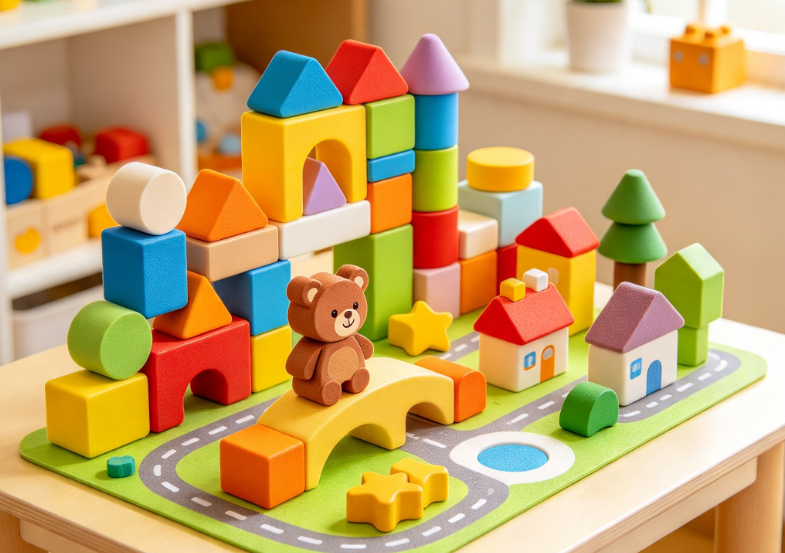
Your 14-month-old picks up a block. She chews the corner, drops it, and watches it bounce. Then she does it again, twelve more times.
That isn't random. It's research. At this age, every block is a test of weight, texture, sound, and taste. Foam blocks let toddlers run those tests safely. They're soft when thrown and quiet when dropped, and they're light enough for small hands to stack.
Not all foam blocks are equal, though. Some are dense and tough. Others crumble the first time a new tooth finds them. The labels matter too. A block sold in the US follows different rules than one sold in the EU.
This guide shows you how to find the best foam building blocks for toddlers at each stage from 12 months to 3 years. You'll learn:
- What toddlers do with blocks at 12–18 months, 18–24 months, and 2–3 years
- How to read US and EU safety labels in under a minute
- The real difference between EVA foam and EPE foam
- The right size and weight for each age
- A simple first-week plan for introducing blocks
- How to keep foam blocks useful for two full years and beyond
---
Why Foam Comes First
Wooden blocks are classic. Plastic interlocking bricks are fun. For children under 3, foam often comes first for good reasons.
| Feature | Foam Blocks | Wooden Blocks | Small Plastic Bricks |
|---|---|---|---|
| Safe to throw indoors | Yes | No | No |
| Quiet when towers fall | Yes | Loud | Loud |
| Easy for small hands to grip | Yes | Depends on size | Hard |
| Safe to mouth | Yes, if certified and intact | Yes, if finished safely | No. Choking hazard |
| Bath and water play | EVA only | No | No |
Foam also suits apartments and homes with a sleeping baby down the hall. A falling tower makes a soft thud, not a crash.
---
Step 1: Match the Block to Your Toddler's Stage
Age on the box is a starting point. Your child's skills tell you more. Use this table as a guide, not a deadline. Every toddler moves at their own pace.
| Stage | What You'll See | Block Goals | What to Look For |
|---|---|---|---|
| 12–18 months | Grabbing, mouthing, dropping, banging two blocks together. Early stacking of 2–3 blocks | Grip, cause and effect, texture exploration | Large, simple shapes. 6–12 blocks. Smooth edges. Bite-resistant foam |
| 18–24 months | Stacking 4–6 blocks, knocking towers down, lining blocks up, carrying blocks around | Hand-eye coordination, balance, early sorting | Mixed shapes: cubes, rectangles, arches. 15–25 blocks. Bright, distinct colors |
| 2–3 years | Towers of 6–10 blocks, simple bridges, walls, pretend play ("This is a house") | Planning, spatial thinking, first problem solving, early counting | 25–50 blocks. Varied sizes. Shapes that support building: cylinders, triangles, long planks |
12–18 Months: The Explorer Stage
Expect more knocking down than building. That's normal. Your child is learning that actions cause results. Pick a small set of big cubes. Too many blocks overwhelm at this age, and they end up under the sofa.
Assume every block goes in the mouth. Material and bite resistance matter most here.
18–24 Months: The Stacker Stage
Now towers happen. Short ones, then taller ones. Toddlers also start carrying blocks from room to room and lining them up in rows. Add rectangles and arches. Variety gives them new problems to solve.
2–3 Years: The Builder Stage
Building gets intentional. Your child points to a stack and calls it a castle. Bridges appear. Blocks become cars, phones, and cakes. This is the stage to add more blocks, more shapes, and simple pretend-play props like animal figures (sized for under 3).
PRO TIP: Buy for the stage your child is in now, with a few extra shapes for the next one. Add more blocks later instead of buying a giant set on day one.
---
Step 2: Read the Safety Labels Like a Pro
Safety labels look technical. They aren't hard to check. Here's what to find on the box or product page.
In the United States
| Label or Standard | What It Covers |
|---|---|
| ASTM F963 | The main US toy safety standard. Covers sharp edges, small parts, materials, and more |
| CPSIA compliance | Federal limits on lead and certain phthalates in children's products |
| Children's Product Certificate (CPC) | The seller's written proof of third-party lab testing. Reputable shops provide it on request |
| Small parts rule | Toys for children under 3 must have no parts that fit inside a standard test cylinder about 1.25 inches (3.17 cm) wide |
In the European Union
| Label or Standard | What It Covers |
|---|---|
| CE mark | The manufacturer's declaration that the toy meets EU toy safety rules |
| EN 71-1 | Mechanical and physical safety, including small parts, edges, and strength tests |
| EN 71-2 | Flammability |
| EN 71-3 | Limits on heavy metals that can migrate out of toy materials |
| Formamide limits | The EU limits formamide, a chemical sometimes found in foam toys. Certified foam stays within these limits |
UK buyers: Look for the UKCA mark or CE mark. Both appear on toys sold in Great Britain.
Watch for This Warning
If a foam block set says "Not suitable for children under 36 months," it isn't a toddler toy. This happens more than you'd think. Some foam building sets include small connector pieces or thin parts. Skip them until age 3.
SAFETY FIRST: No certification marks on the box or product page? Don't buy it for a child under 3. Price is never worth the risk.
🧸 Check age ratings and safety details before you buy. Browse toddler-friendly sets at BrickHobby.
---
Step 3: Choose the Right Foam: EVA vs. EPE
Two foams show up most often in toddler blocks. They look similar in photos. In a toddler's mouth, they behave very differently.
| Feature | EVA Foam | EPE Foam |
|---|---|---|
| Full name | Ethylene-vinyl acetate | Expanded polyethylene |
| Feel | Dense, smooth, slightly rubbery | Light, airy, very soft |
| Bite resistance | Good. Holds up to chewing | Poor. Tears and crumbles more easily |
| Shape over time | Holds crisp edges | Dents and squashes |
| Water | Water-resistant. Good for bath play | Absorbs less water than open foam, but not ideal for baths |
| Stacking | Stable. Towers stand straighter | Lighter blocks topple faster |
| Weight | Heavier, but still soft | Very light |
| Best for | Most toddlers, especially active chewers | Large, oversized blocks where low weight matters most |
Our Recommendation
For most toddlers, EVA foam is the better choice. It survives teething, wipes clean, and stacks well. EPE works for very large, lightweight blocks, like giant blocks for building forts, as long as you check them often for damage.
What About Covered Foam Blocks?
Some large soft-play blocks use a foam core inside a vinyl or fabric cover. These are great for climbing and big-body play. Check that zippers are hidden or secured, seams are tight, and the cover is wipeable. A torn cover exposes foam that toddlers can bite off.
Do the Smell Test
New foam can have a light smell when you open the box. A quality block's smell fades after a day or two of airing out. A strong chemical smell that lasts is a red flag. Return it.
---
Step 4: Get the Size and Weight Right
Size protects against choking. Weight protects against bumps when blocks get thrown, and they will get thrown.
Size Guidelines
| Stage | Smallest Block Size | Why |
|---|---|---|
| 12–18 months | At least 2.5 in (about 6 cm) on every side | Easy two-hand grip, far too big to fit in the mouth |
| 18–24 months | At least 2 in (about 5 cm) | Easier one-hand stacking, still safely large |
| 2–3 years | At least 1.75 in (about 4.5 cm), plus larger blocks | More building precision without small-part risk |
The Toilet Paper Tube Check
Here's a quick home test many pediatric safety groups suggest. A toilet paper tube is about 1.75 inches wide. That's wider than the official small parts cylinder. If any block, or any piece that comes off a block, slides through the tube, keep it away from your toddler.
It's not a lab test. It's a fast, cautious double-check.
Weight Guidelines
Lighter is safer for throwing. Heavier is better for stacking. Look for the middle.
- Small and medium blocks: Light enough that a toss at a sibling doesn't hurt. Most EVA toddler blocks weigh well under 100 g each.
- Giant blocks: Big but feather-light, so a falling fort doesn't knock anyone over.
PRO TIP: Hold a block and gently tap it on your own forearm. If it stings, it's too dense for a 12-month-old who throws.
---
Step 5: Inspect Blocks Before Play and Every Week After
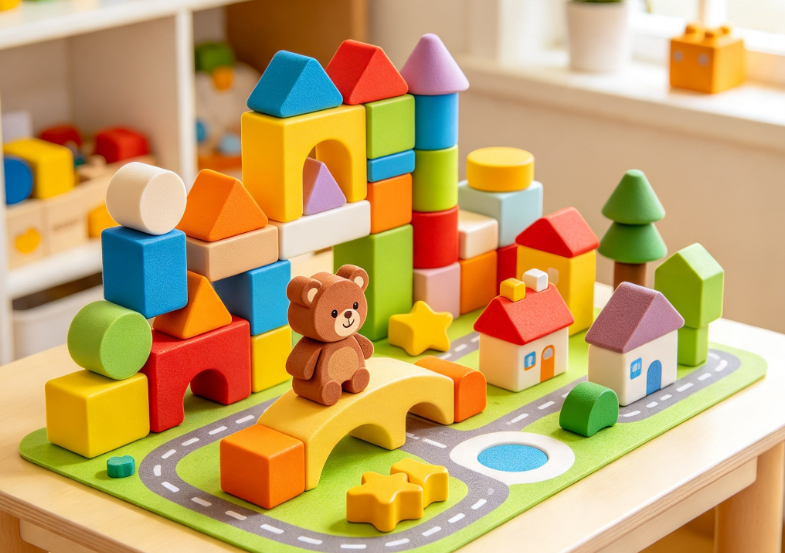
Foam wears down. Even the best foam building blocks for toddlers need regular checks. Make inspection a habit. It takes two minutes.
Out of the Box
- Squeeze each block. It should spring back.
- Pinch the corners. They shouldn't flake or crumble.
- Check for loose printed layers or peeling stickers.
- Count the blocks. Write the number on the storage bin.
Every Week
- Look for bite marks, especially on corners and edges
- Run your hand over each surface to feel for tears
- Check painted or printed areas for peeling
- Toss any block with a missing chunk
That last point matters most. A bitten-off piece of foam is a choking hazard. Damaged blocks go in the trash, not back in the bin.
Keep Them Clean
| Task | How Often | How |
|---|---|---|
| Wipe down | Weekly, or after illness | Warm water and mild soap on a cloth |
| Air dry | After every wash or bath | Spread out on a towel. Let dry fully |
| Deep check | Monthly | Look inside crevices and hollow shapes for mold |
Skip the dishwasher and harsh cleaners. Heat can warp foam, and strong chemicals break it down.
---
Step 6: Introduce Foam Blocks Safely: A First-Week Plan
A slow start keeps the first week calm. It also gives you time to see how your toddler uses the blocks.
| Day | What to Do | What to Watch |
|---|---|---|
| Day 1 | Sit on the floor with 4–6 blocks. Let your child touch, squeeze, and mouth them | Chewing strength. Any bite marks? |
| Day 2 | Stack 2 blocks. Knock them down together. Laugh! | Interest in cause and effect |
| Day 3 | Add 2–4 more blocks. Hand blocks over one at a time | Grip and passing between hands |
| Day 4 | Build a short tower and pause. Let your child finish it | First stacking attempts |
| Day 5 | Put blocks in a basket. Practice dumping and refilling | Early sorting and cleanup habits |
| Days 6–7 | Leave the basket out during supervised play | Independent play length |
Ground Rules for Every Session
- Supervise. Always stay in the room with children under 3.
- Floor play only. A soft rug or play mat works best.
- No blocks in cribs or car seats. Keep sleep and travel spaces clear.
- Stop when interest fades. At 12–18 months, five minutes is a good session.
Siblings and Builder Parents
Many families who love building have older kids or grown-ups with small bricks in the house. Set up a two-zone home. Small bricks stay at the table or behind a closed door. Foam blocks live on the floor. Do a quick floor sweep after big kids build. One stray 1x1 brick is all it takes.
---
Step 7: Use Foam Blocks for Sensory Play
Foam does more than stack. Its soft, squishy feel makes it a strong sensory toy. Try these simple ideas.
Touch and Squeeze
Hand your toddler one block at a time. Name what they feel: "Soft. Squishy. Smooth." Mix textured blocks with smooth ones if your set includes them. Words plus touch builds early vocabulary.
Bath Time Building
EVA blocks float and stick to wet tile walls. Toddlers love pressing them on and pulling them off. Squeeze out water after the bath and dry the blocks fully. Never leave them wet in a closed bin.
Push and Carry
Giant foam blocks give toddlers heavy-work play. Pushing a big block across the room or carrying one with both arms builds strength and body awareness. It's also great on a rainy afternoon.
Sound Games
Drop a foam block. Drop a wooden spoon. Compare the sounds. "Thud. Clang!" Simple contrasts teach cause and effect.
Color Hunts (18 Months and Up)
Ask, "Can you find a red one?" Start with two colors. Add more as your child succeeds. Celebrate every find.
🎉 Want more shapes and colors for sensory play? Explore toddler and family building sets at BrickHobby.
---
Step 8: Extend Play Value Over Time
A good foam set doesn't end at age 2. With a few tricks, it stays useful until your child moves on to bigger building.
Rotate the Blocks
Keep half the set in a closet. Every two weeks, swap them. Old blocks feel new again, and your toddler stays interested without you buying anything.
Grow the Challenges
| Age | Challenge |
|---|---|
| 12–18 months | Knock down a 2-block tower |
| 18–24 months | Build a tower as tall as a stuffed bear |
| 2 years | Build a "road" in a straight line across the rug |
| 2.5 years | Build a bridge for a toy car to drive under |
| 3 years | Sort blocks by shape, then by color, then by size |
Add Simple Props
Toy animals, small cars, and a cardboard box turn blocks into a farm, a garage, or a zoo. Pick props sized for under 3. Pretend play is where many toddlers start talking about what they build.
Plan the Next Step
Around age 3, many children are ready for larger interlocking blocks designed for small hands. These still avoid small parts and teach the "click" of connecting pieces. By age 5 or 6, most kids move on to standard-size bricks with instructions.
Foam blocks don't disappear at that point. Many families keep them for fort building, bath play, and younger siblings. The best foam building blocks for toddlers often get passed down for years.
🧱 Plan your child's building journey from soft blocks to first brick sets. Shop the full range at BrickHobby.
---
Common Mistakes to Avoid
| Mistake | Why It's a Problem | Fix |
|---|---|---|
| Buying foam sets rated 3+ for a younger toddler | Small parts or weak foam | Check the age warning on every box |
| Ignoring bite marks | Loose foam is a choking hazard | Inspect weekly. Toss damaged blocks |
| Choosing EPE for a heavy chewer | Soft foam tears faster | Pick dense EVA foam |
| Starting with 50+ blocks | Overwhelm and scattered pieces | Start with 6–12, then add more |
| Leaving bath blocks wet | Mold inside crevices | Squeeze and dry fully after every bath |
| Mixing toddler and big-kid toys | Small bricks end up on the floor | Use a two-zone setup |
| Skipping certification checks | Unknown materials and chemicals | Look for ASTM F963, CPSIA, CE, EN 71 |
---
Your Quick Buying Checklist
- ✅ Matches your toddler's current stage
- ✅ ASTM F963 and CPSIA (US) or CE and EN 71 (EU) listed
- ✅ No "under 36 months" warning
- ✅ Dense EVA foam for chewers
- ✅ Every block too big for a toilet paper tube
- ✅ Light enough to throw safely
- ✅ No strong chemical smell after airing out
- ✅ Wipeable surface
- ✅ Right number of blocks to start: 6–12 for young toddlers
---
Build Safely From the First Block
Choosing foam blocks is simple once you know what to check. Start with your toddler's stage. Confirm the safety labels. Pick dense, bite-resistant foam in sizes that can't be swallowed. Introduce blocks slowly, inspect them weekly, and keep play fresh with rotation and new challenges.
Do that, and the first tower your child knocks down won't be the last. It's the start of years of building together.
🧸 Find your first set: Shop BrickHobby
---
Frequently Asked Questions
What are the best foam building blocks for toddlers aged 12 to 18 months?
The best foam building blocks for toddlers at this age are large, dense EVA cubes at least 2.5 inches (about 6 cm) on each side. Start with 6 to 12 blocks in simple shapes. Look for ASTM F963 and CPSIA compliance in the US, or the CE mark and EN 71 in the EU. Bite resistance matters most, since nearly every block goes in the mouth.
Is EVA foam safe for toddlers to chew?
Certified EVA foam is a common, safe choice for toddler toys. It's dense and holds up better to chewing than softer foams. Still, check blocks every week for bite marks. If a toddler bites off a piece, throw the block away. No foam is safe once it starts breaking apart.
How do I know if a foam block is a choking hazard?
Toys for children under 3 must not have parts that fit inside the official small parts cylinder, about 1.25 inches wide. For a quick home check, use a toilet paper tube. If a block or any piece of it slides through, keep it away from your toddler. Also check for torn corners, which create new small pieces.
Can foam building blocks go in the bath?
EVA foam blocks work well in the bath because they resist water and float. After each bath, squeeze out water and let blocks dry fully on a towel. Check hollow or textured areas for mold every month. EPE foam and fabric-covered blocks aren't good choices for water play.
When should my child move from foam blocks to interlocking bricks?
Most children are ready for large interlocking blocks made for small hands around age 3. Standard-size bricks with small parts usually suit ages 5 and up. Follow the age rating on every set. Many families keep foam blocks long after, for forts, bath play, and younger siblings.
Ready to build this yourself?
BrickHobby sells high-quality LEGO-alternative building block sets — the same brick standard, a fraction of the price. Browse our in-stock sets and simply contact our customer service team to place your order; we will confirm availability, pricing and worldwide shipping for you.
Keep reading

Kids & Toddlers Bricks
How to Choose the Best Magnetic Building Toys for Kids
Learn how to choose the best magnetic building toys for kids, from safety tips to picking the right set for your child's age and skill level.
Kids & Toddlers Bricks
How to Pick the Best Programmable Building Toys for Kids (And Actually Use Them)
Learn how to choose, set up, and get the most from the best programmable building toys for kids — plus why BrickHobby is a great LEGO-compatible pick.
Kids & Toddlers Bricks
How to Choose the Best STEM Building Toys for Kids in 2026
Find the best STEM building toys for kids in 2026 with this age-by-age guide covering safety, materials, and smart LEGO alternatives.